- Company News
- 2026-05-17
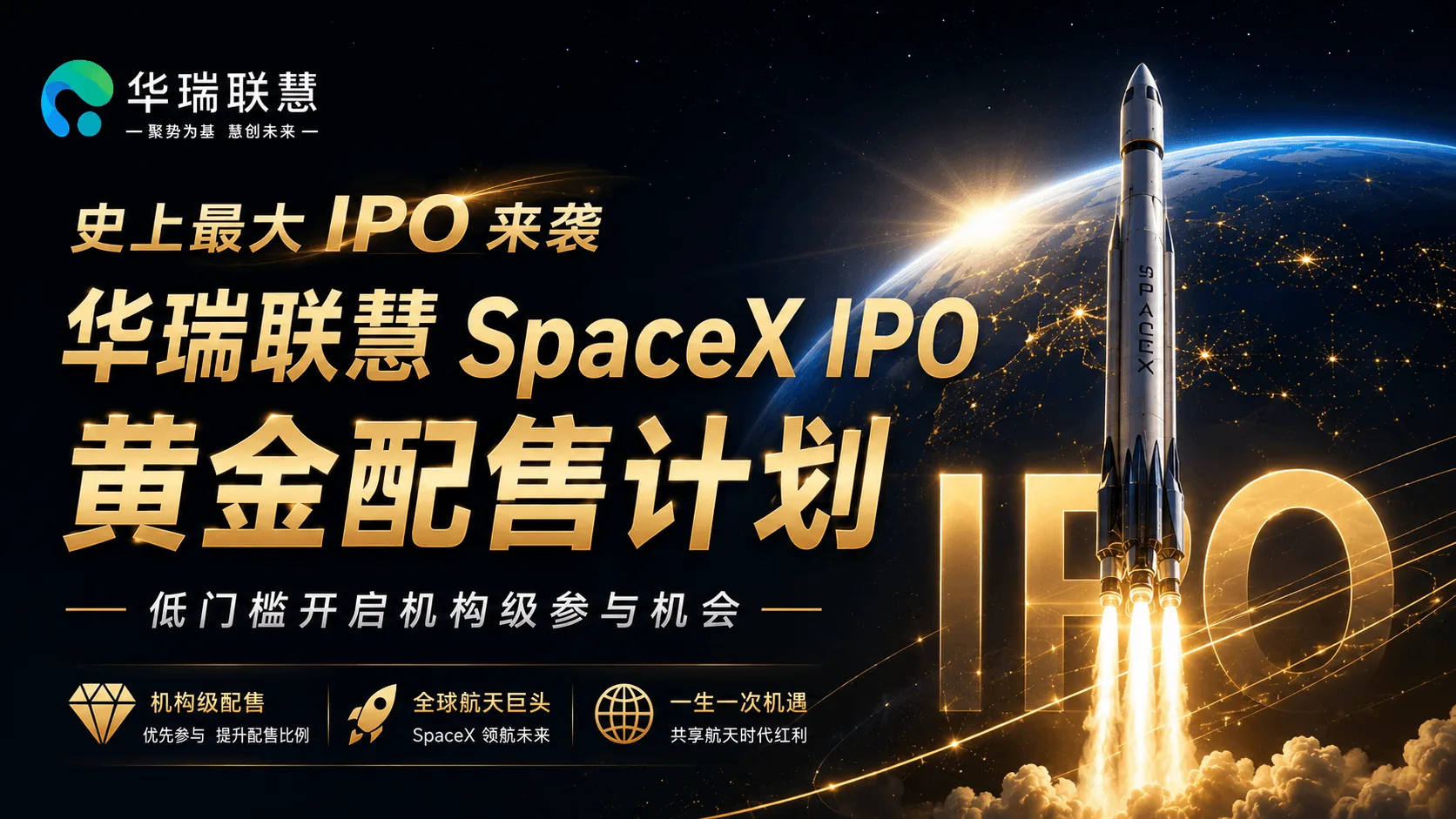
The largest IPO in history is coming! Huarui Lianhui launches a golden allocation plan for SpaceX's IPO, opening up opportunities for institutional participation with low barriers to entry.
A Super Opportunity: The "Largest IPO in History"
Space Exploration Technologies Corp. (SpaceX), founded by Elon Musk in 2002 and headquartered in Hawthorne, California, established its ambitious mission from the outset: to "accelerate space exploration, reduce the cost of space access, and ultimately enable humanity to become a multiplanetary species." After more than two decades of technological accumulation and commercial innovation, SpaceX has firmly established itself as the absolute leader in the global private space industry. Its core businesses have formed two highly synergistic strategic segments: rocket launches and satellite internet, building a vertically integrated industrial ecosystem that is difficult to replicate.
In the field of rocket launches, SpaceX has achieved disruptive changes in the space industry with its reusable rocket technology. Its Falcon 9 reusable rocket has become a dominant force in the global commercial launch market, with an orbital mass ratio approaching 90%. The Block 5 version of this rocket has undergone hundreds of successful flights, demonstrating a reliability of over 99.5%, and has repeatedly achieved a record of more than 30 re-flights using the same booster. This technological breakthrough significantly reduces the cost per launch, driving the global commercial space industry from the traditional "one-off" model to "aerospace-grade" high-frequency reusable operations. The Falcon Heavy launch vehicle further expands deep-space mission capabilities, while the next-generation super-heavy rocket, Starship, is undergoing accelerated testing and iteration. This fully reusable system, equipped with high-performance Raptor engines, is capable of delivering payloads weighing hundreds of tons into low Earth orbit, supporting NASA's manned lunar landing program, Mars colonization missions, and large-scale satellite constellation deployments. Multiple Starship orbital flight tests are expected to be conducted intensively in 2026, marking a fundamental reshaping of the space transportation economic model.
In the satellite internet sector, the Starlink low Earth orbit (LEO) constellation has become SpaceX's core growth engine and cash flow pillar. Since the official launch of beta testing in 2021, Starlink has deployed over 9,500 satellites, serving over 10 million active users globally (approximately 9 million+ by the end of 2025, with continued rapid growth in 2026), establishing its position as the world's largest satellite internet operator. Starlink has broken through the geographical limitations of traditional terrestrial fiber optic cables and base stations, providing high-speed, low-latency, reliable connectivity for remote areas, aviation, maritime, military, and emergency communication scenarios. Its enterprise and government contract business has further expanded into the aviation, maritime, and defense sectors, forming a stable and high-margin revenue stream. In February 2026, SpaceX and Elon Musk's xAI completed a strategic merger. This landmark integration not only strengthened the deep synergy between aerospace infrastructure and artificial intelligence but also laid a solid foundation for future space data centers, orbital edge computing, and Direct-to-Cell (satellite-to-phone) technology, significantly expanding the company's long-term growth boundaries.
SpaceX also undertakes numerous key contracts with NASA and the U.S. Department of Defense, including the routine operation of the Crew Dragon crew capsule, which has successfully transported dozens of astronauts safely to and from the International Space Station. These achievements collectively build SpaceX's technological, cost, and ecosystem barriers in the global aerospace industry, enabling it to maintain a leading edge in the increasingly competitive space economy.
Strong Financial Performance and High Growth Potential
Based on market estimates for 2025, SpaceX's annual revenue is projected to be approximately $15-16 billion, with Starlink contributing approximately $11-11.4 billion, accounting for over 60-70%. The company's adjusted EBITDA is expected to be around $8 billion, with Starlink boasting a gross margin exceeding 60%, making it the primary profit driver and source of free cash flow. Revenue in 2024 was approximately $13.1 billion, and a robust year-on-year growth of 15-40% is expected in 2025. In 2026, Starlink revenue is projected to further expand to $15.9-18.7 billion, or even higher, continuing to drive overall performance growth. While Starlink faces some downward pressure on ARPU (Average Revenue Per User) due to global expansion and price optimization, the scale effect is significant. Over 4.6 million new users are expected in 2025, bringing the total number of global subscribers to over 10 million. Rapid penetration into enterprise contracts and government projects further optimizes the revenue structure and enhances counter-cyclical capabilities. Starlink's strong positive free cash flow has not only supported rocket development and Starship iterations but also provided a solid financial backing for the AI infrastructure construction following the xAI merger.
Currently, through secondary market transactions, SpaceX's private valuation has rapidly climbed to approximately $800 billion to $1.25 trillion. The IPO target valuation range is $1.75 trillion to $2 trillion (some optimistic forecasts are even higher), potentially making it one of the world's most valuable listed companies, comparable to or surpassing tech giants like Meta, and approaching the size of Amazon. This high valuation reflects the capital market's strong confidence in the company's long-term prospects: Starlink's monopolistic recurring revenue, Starship's disruptive potential, and the emerging growth curve driven by the integration of aerospace and AI. Of course, high valuations also come with execution risks and pressure from multiples (P/S ratios are at a high level), and ultimate performance depends on the company's continued delivery of technological and commercial milestones.
SpaceX's IPO is taking place at a historical juncture of rapid expansion in the global space economy. According to authoritative industry forecasts, the global space economy reached nearly $450 billion in 2025 and is projected to maintain a compound annual growth rate of approximately 7% between 2026 and 2033, potentially exceeding $780 billion by 2033. Satellite communications, commercial launches, space infrastructure, and orbital services will be the main growth engines, and SpaceX is the most representative leading company in this grand wave. SpaceX is expected to officially list in mid-to-late June 2026 (roadshow has already begun), with a fundraising target of $50-75 billion, breaking Saudi Aramco's record and becoming the largest IPO in the history of the global capital market. Musk has specifically planned a retail/individual investor allocation ratio of up to 30%, far exceeding the traditional 5-10% of IPOs, demonstrating an open attitude towards broad investor participation. Currently, it is in a critical window after the confidential filing of the S-1 document, roadshow, and pricing; locking in the allocation share early will be a key factor affecting the final return. Retail demand is expected to be extremely strong, coupled with the global attention on the space theme, this IPO will undoubtedly be a landmark event in the technology investment field in 2026.
For investors in Hong Kong and Greater China, this opportunity holds special strategic significance. With increasingly convenient cross-border investment through the Stock Connect and US stock markets, participating in the SpaceX IPO is not merely a financial investment in a single company, but a strategic move to proactively position oneself in the global space economy and share in the dividends of commercialized human spaceflight. Against the backdrop of accelerated digital transformation and a more complex geopolitical environment, the strategic value of satellite internet is becoming increasingly prominent, and SpaceX's leading technology and execution capabilities make it the best entry point.
A Historic Opportunity Amidst the Global Space Economy Wave
As the global capital market is about to witness a historic moment, Huarui Lianhui's SpaceX IPO Golden Placement Plan has officially launched. This product aims to provide qualified investors with a low-threshold, high-efficiency participation path, helping them seize the IPO opportunity of Space Exploration Technologies Corp. (SpaceX), a leading global aerospace company. As a benchmark company in aerospace technology and satellite communications, SpaceX's listing is expected to be one of the largest and most influential IPOs in 2026 and even in the history of the capital market. Through cooperation with professional institutions, this plan aggregates resources and participates in bookbuilding as an institutional investor, opening a "once-in-a-lifetime" super investment window in aerospace and technology for investors. The Golden Ticket to the Largest IPO in History—Low Threshold, Institutional-Level Allocation Opportunity
The Huarui Lianhui SpaceX IPO Golden Allocation Plan is a product meticulously designed to seize this historic opportunity. Its core concept is "institutional-level treatment, inclusive participation."
This plan establishes deep strategic partnerships with the regulated issuer, Republic, and several international/Hong Kong licensed securities firms and fund platforms to acquire institutional book-building shares in the SpaceX IPO. By aggregating qualified investor funds to establish a dedicated subscription SPV, participating in the book-building process as an institution, it significantly improves the overall allocation ratio, priority, and subscription efficiency. Compared to traditional retail IPO channels, this plan greatly reduces the financial threshold and operational complexity for individual investors, while providing professional, end-to-end support services.
Key product features include:
1. Low-threshold subscription model: Adopting an investment-based subscription method, all eligible users can participate. The minimum subscription amount is set affordably (subject to the official product documents), suitable for high-net-worth individual investors, technology and aerospace enthusiasts, family offices, and small and medium-sized institutional investors.
2. Institutional-Level Professional Services: Provides real-time IPO progress tracking, professional valuation model analysis, multi-scenario risk simulation (covering interest rate fluctuations, geopolitical impacts, technological execution variables, and macroeconomic cycles), in-depth interpretation of expert roadshow presentations, and instant updates on Elon Musk's activities and market hot topics.
3. Transparent Custody and Compliance Risk Control: All subscription funds are strictly managed by an independent custodian bank, fully complying with the regulatory requirements of applicable local jurisdictions, ensuring process transparency, fund security, and investor protection.
4. Post-IPO Ongoing Support: After share unlocking, provides professional portfolio management tools, one-click trading options, long-term allocation advice, and dynamic rebalancing strategies to help investors optimize exit timing and overall asset allocation based on market changes.
This plan not only focuses on the economic performance of SpaceX stock alone but also on its deep integration into the industry. Through this approach, qualified investors can truly enjoy institutional-level allocation benefits and seize the key value release window of SpaceX's transformation from a private company to a publicly traded company.
Investment Value, Strategic Significance, and Comprehensive Risk Considerations
The strategic significance of participating in the SpaceX IPO is multifaceted: first, sharing in the stable benefits of Starlink's high profit margins and scalable recurring revenue; second, positioning oneself for the space transportation revolution and deep space exploration opportunities driven by Starship; and third, seizing the potential of emerging sectors arising from the integration of aerospace infrastructure and artificial intelligence. Against the backdrop of global digitalization, the wave of exploration, and sustainable development, SpaceX represents humanity's confident investment in the future space age.
The SpaceX IPO is not only a major event in the capital market but also a significant milestone in the shift of human spaceflight from government-led initiatives to full commercialization. Huarui Lianhui's SpaceX IPO Golden Allocation Plan provides you with a professional, compliant, efficient, and low-threshold participation channel. At this golden juncture, Huarui Lianhui invites you to witness and share in the investment dividends of the global space age.