
- Industry Analysis
- 2026-08-19
2026: The Turning Point for AI at Scale
A Global Overview of the Artificial Intelligence Market and Future Development Trends
In 2026, the artificial intelligence industry is crossing a critical threshold.
If 2023 marked the beginning of generative AI’s entry into the mass market, 2024 was the year enterprises accelerated AI experimentation, and 2025 saw a broad surge in investment in computing infrastructure, then 2026 can more accurately be described as the turning point when AI shifts from a race for technological capability toward large-scale deployment and return-on-investment validation.
Market attention is moving away from the question of “What can AI models do?” toward a more practical one: Can AI generate real revenue, reduce costs, improve efficiency, and create sustainable cash flow?
Infrastructure continues to expand, AI agents are beginning to integrate into enterprise workflows, and inference demand is rising rapidly. At the same time, capital markets and corporate management teams are applying greater scrutiny to utilization rates, unit economics, and return on investment.
Global AI Spending Expected to Reach $2.59 Trillion
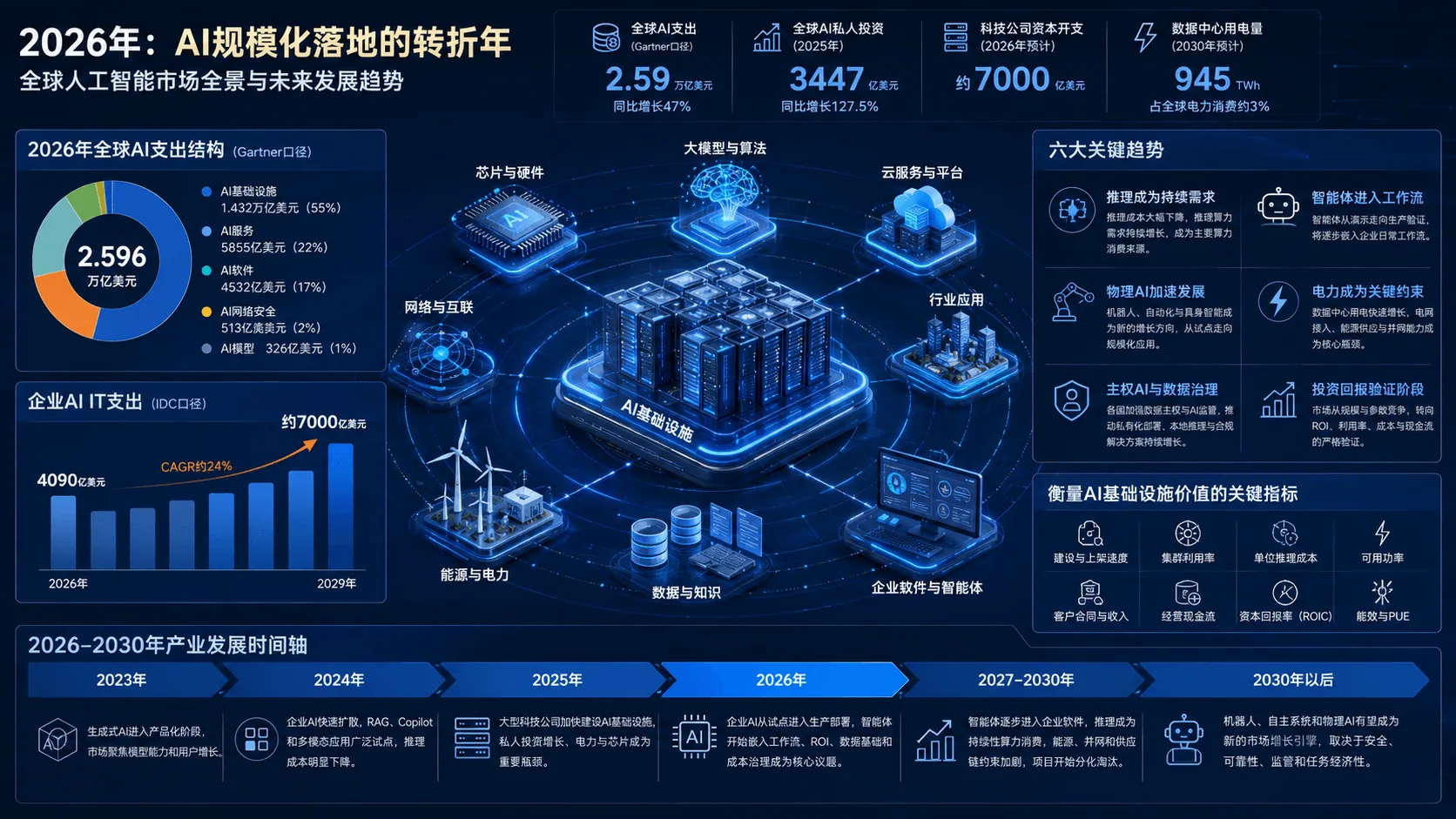
According to a forecast released by Gartner in May 2026, global AI-related spending is expected to reach $2.596 trillion in 2026, representing year-over-year growth of 47%, and is projected to rise further to $3.493 trillion in 2027.
By spending category, AI infrastructure continues to dominate:
- AI infrastructure: approximately $1.432 trillion
- AI services: approximately $585.5 billion
- AI software: approximately $453.2 billion
- AI cybersecurity: approximately $51.3 billion
- AI models: approximately $32.6 billion
AI infrastructure accounts for approximately 55% of total global AI spending in 2026, indicating that current market growth remains primarily driven by chips, servers, networking, data centers, and AI-optimized cloud infrastructure.
Using a narrower definition focused on enterprise AI IT spending, IDC estimates that global AI IT expenditure will reach approximately $409 billion in 2026, up around 53% year over year, and could approach $700 billion by 2029.
These two sets of figures are not contradictory. Gartner’s methodology covers a broad range of areas, including AI semiconductors, endpoint devices, servers, cloud infrastructure, software, and services, while IDC focuses more specifically on IT spending by enterprises and service providers to build and operate AI systems.
Regardless of the methodology used, artificial intelligence has already expanded beyond a standalone software market into an integrated industrial ecosystem encompassing chips, data centers, electricity, cloud services, enterprise software, and professional services.
AI Investment Continues to Rise as Capital Concentrates Among Market Leaders
According to Stanford University’s AI Index Report 2026, global private investment in AI reached $344.7 billion in 2025, representing year-over-year growth of 127.5%.
Of this total, generative AI attracted approximately $170.9 billion in private investment, accounting for nearly half of all global private AI investment and increasing by more than 200% compared with 2024.
The accelerating flow of capital into AI demonstrates continued confidence in the long-term potential of large models, computing platforms, and enterprise AI applications.
However, the increasing concentration of investment also means that future competition will depend more heavily on capital strength, infrastructure capabilities, customer resources, and commercialization efficiency.
Fundraising scale will no longer be the sole measure of an AI company’s value. Markets will increasingly evaluate whether AI companies can translate technological capabilities into stable revenue—and whether that revenue growth can cover the costs of model training, inference, talent, and infrastructure.
Global Computing Capital Expenditure Enters the $700 Billion Range
According to an analysis published by the International Energy Agency in April 2026, capital expenditure by five major technology companies exceeded $400 billion in 2025 and is expected to increase by approximately 75% in 2026. At that rate, combined capital expenditure would approach $700 billion.
As of August 2026, several major technology companies have already announced substantial capital expenditure plans:
- Microsoft expects calendar-year 2026 capital expenditure of approximately $190 billion
- Alphabet expects full-year capital expenditure of $175 billion to $185 billion
- Meta expects full-year capital expenditure of $130 billion to $145 billion
- Amazon recorded $43.2 billion in cash capital expenditure in the first quarter of 2026 alone, primarily supporting technology infrastructure and AWS expansion
Not all of this spending is directly attributable to AI. Nevertheless, AI servers, data centers, chips, networking, and power infrastructure have become major drivers of capital expenditure growth.
As capital investment rises rapidly, depreciation, energy expenses, finance leases, and operating costs are increasingly flowing through corporate financial statements.
The AI infrastructure industry is therefore transitioning from a phase of “securing computing capacity” to one of “validating returns on computing infrastructure.”
Key metrics for evaluating future computing infrastructure projects will include:
- Construction and deployment speed
- Available power capacity
- Customer contracts
- Cluster utilization
- Unit inference cost
- Operating cash flow
- Return on invested capital
AI Is Shifting from Training Toward Continuous Inference
Over the past several years, market attention has largely focused on the training of large AI models. As enterprise AI moves into production environments, however, inference is becoming a more frequent and persistent source of computing demand.
Microsoft has disclosed that through combined hardware and software optimization, inference throughput for its commonly used models has improved by 40%.
Stanford’s AI Index data also shows that the cost of querying a model with capabilities comparable to GPT-3.5 fell by more than 280-fold between November 2022 and October 2024.
Rapidly declining inference costs are enabling enterprises to deploy AI more broadly across areas such as:
- Customer service
- Software development
- Knowledge management
- Marketing
- Financial analysis
- Industrial production
However, lower inference costs do not necessarily mean lower overall enterprise AI spending.
AI agents often need to perform multiple steps—including planning, retrieval, tool invocation, and result verification. As a result, the token consumption required to complete a single task can be significantly higher than that of a conventional conversational interaction.
The key competitive metric of the future will therefore not simply be the price per million tokens, but rather the total cost, accuracy, and success rate of completing a real-world business task.
AI Agents Are Entering Enterprise Workflows
In 2026, AI agents are moving beyond demonstrations and into enterprise production validation.
Gartner expects that by 2028, 33% of enterprise software applications will incorporate agentic AI capabilities, while at least 15% of day-to-day work decisions will be made autonomously by AI agents.
At the same time, Gartner also expects that more than 40% of agentic AI projects may be canceled by the end of 2027 due to rising costs, unclear business value, or inadequate risk controls.
This means the AI agent market is likely to experience both rapid expansion and equally rapid elimination.
The first agents to achieve large-scale adoption may not be fully autonomous “digital employees.” Instead, they are more likely to be task-oriented agents with clearly defined boundaries, controlled permissions, and auditable outputs, including applications such as:
- Software development and code review
- Enterprise knowledge retrieval
- Customer service
- Document processing
- Financial analysis
- Supply chain monitoring
- Equipment operations and maintenance
- Risk identification
Whether enterprises can generate real value from AI agents will depend on how deeply those agents can integrate with business systems, enterprise data, and operational workflows—not simply on adding another conversational interface.
Physical AI Will Become the Next Major Growth Frontier
As language-model capabilities mature, artificial intelligence is beginning to move from the digital world into the physical world.
Industrial robotics, warehouse automation, autonomous transportation, intelligent inspection, and embodied AI are expected to become important new sources of AI market growth.
Vision-language-action models, world models, edge inference, and high-precision sensors are enabling robots to develop stronger capabilities in environmental understanding and task execution.
However, physical AI remains in the early stages of transitioning from pilot programs to large-scale deployment.
From 2026 to 2027, market development is expected to remain focused primarily on scenario validation in factories, warehouses, inspection operations, and specialized environments.
Between 2028 and 2030, if reliability, safety, hardware costs, and supply-chain conditions continue to improve, physical AI could enter a much broader phase of commercial deployment.
The criteria used to evaluate physical AI will also shift away from demonstration performance toward measurable operational metrics such as:
- Continuous operating time
- Failure rates
- Cost per task
- Investment payback period
Electricity Is Becoming a Critical Constraint on AI Development
Artificial intelligence is no longer simply a semiconductor and software industry. It is increasingly becoming an energy and infrastructure industry.
According to the International Energy Agency, global data-center electricity consumption reached approximately 415 TWh in 2024, accounting for around 1.5% of global electricity consumption.
By 2030, data-center electricity consumption is expected to more than double to approximately 945 TWh.
At the same time, grid connections, transformers, cooling systems, power supply, and permitting timelines are becoming real bottlenecks in data-center construction.
The IEA estimates that by 2030, approximately 20% of planned global data-center capacity could face delays in securing grid connections.
Future competition in computing infrastructure will therefore expand beyond the performance of individual chips toward system-level efficiency. Key capabilities will include:
- Effective computing performance per watt
- High-speed interconnect and memory efficiency
- Liquid cooling and thermal management
- Cluster scheduling and utilization
- Access to electricity
- Renewable energy and energy-storage deployment
- Data-center site selection and grid connectivity
The integration of computing power and electricity will become a long-term strategic theme in AI infrastructure development.
Sovereign AI and Data Governance Continue to Gain Importance
Artificial intelligence is increasingly being incorporated into national digital sovereignty and industrial security frameworks.
Models, training data, computing nodes, critical chips, and cross-border data flows will face increasingly detailed regulatory requirements.
Industries such as finance, government, healthcare, and critical manufacturing will also place greater emphasis on private, regionalized, and sovereign-cloud deployments.
This trend is expected to drive continued growth in markets including:
- Privately deployed large language models
- Industry-specific knowledge bases
- Local AI inference
- Privacy-preserving computing
- Model security evaluation
- AI compliance auditing
- Hybrid-cloud computing orchestration
- Data access control and audit logging
Compliance will no longer be an optional feature added to AI products. It will increasingly become a fundamental requirement for enterprise AI systems to enter production environments.
The AI Industry Timeline: 2026–2030
2023: Generative AI entered the productization stage, with markets focusing on model capabilities and user growth.
2024: Enterprise AI adoption accelerated rapidly. RAG, Copilot, and multimodal applications entered widespread pilot programs, while inference costs declined significantly.
2025: Major technology companies accelerated investment in AI servers and data centers. Private AI investment rose substantially, while electricity availability and advanced chips emerged as major bottlenecks.
2026: Enterprise AI moves from localized pilots into production deployment. AI agents begin entering workflows, while ROI, data foundations, and cost governance become central priorities.
2027–2030: AI agents gradually become embedded across enterprise software, while inference becomes a persistent source of computing demand. Constraints involving energy, grid connectivity, and supply chains intensify. Infrastructure projects lacking customer contracts, operational efficiency, and effective risk controls will face increasing pressure and potential elimination.
After 2030: Robotics, autonomous systems, and physical AI could become new engines of market growth, although the pace of development will continue to depend on safety, reliability, regulation, and task economics.
Conclusion
2026 is not the “first year” of artificial intelligence. Rather, it represents an important milestone as the AI industry enters an era of large-scale deployment and value validation.
Markets will gradually shift away from focusing primarily on model parameters, fundraising scale, and raw computing capacity. Instead, investors and enterprises will increasingly evaluate real customer demand, business revenue, infrastructure efficiency, and long-term returns on capital.
The companies with sustainable competitive advantages will not simply be those with more chips or larger models.
They will be the companies capable of connecting computing power, data, models, and industry workflows to create stable, auditable, and sustainable business value.
The real long-term competition in the AI industry is only just beginning.