- Investment Analysis
- 2026-08-17
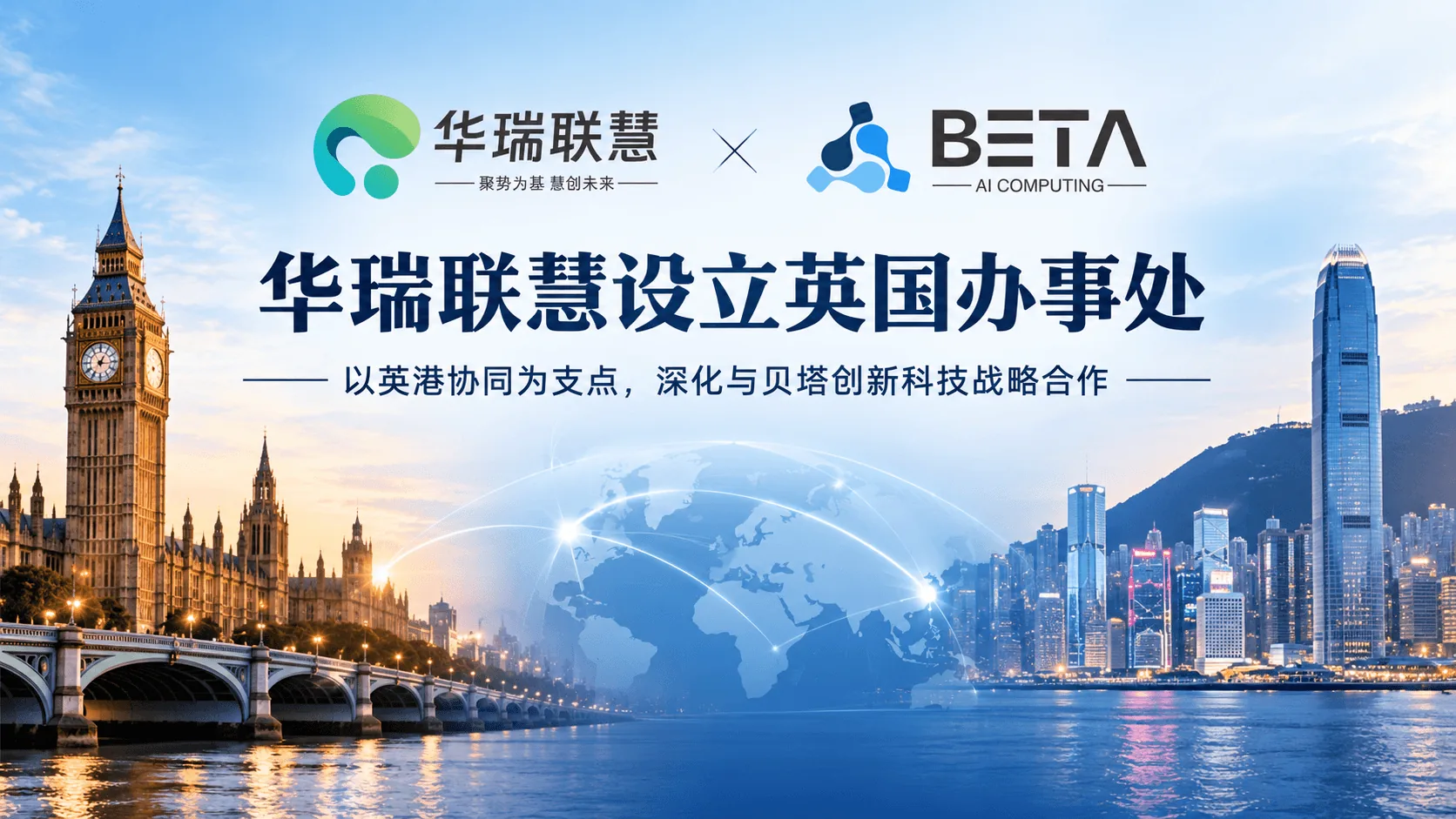
After Eight Months of In-Depth Research, Huarui SmartLink Visits Beta Creative Tech: Discovering “Delivery-Driven Strength” in the Deep Waters of AI Computing
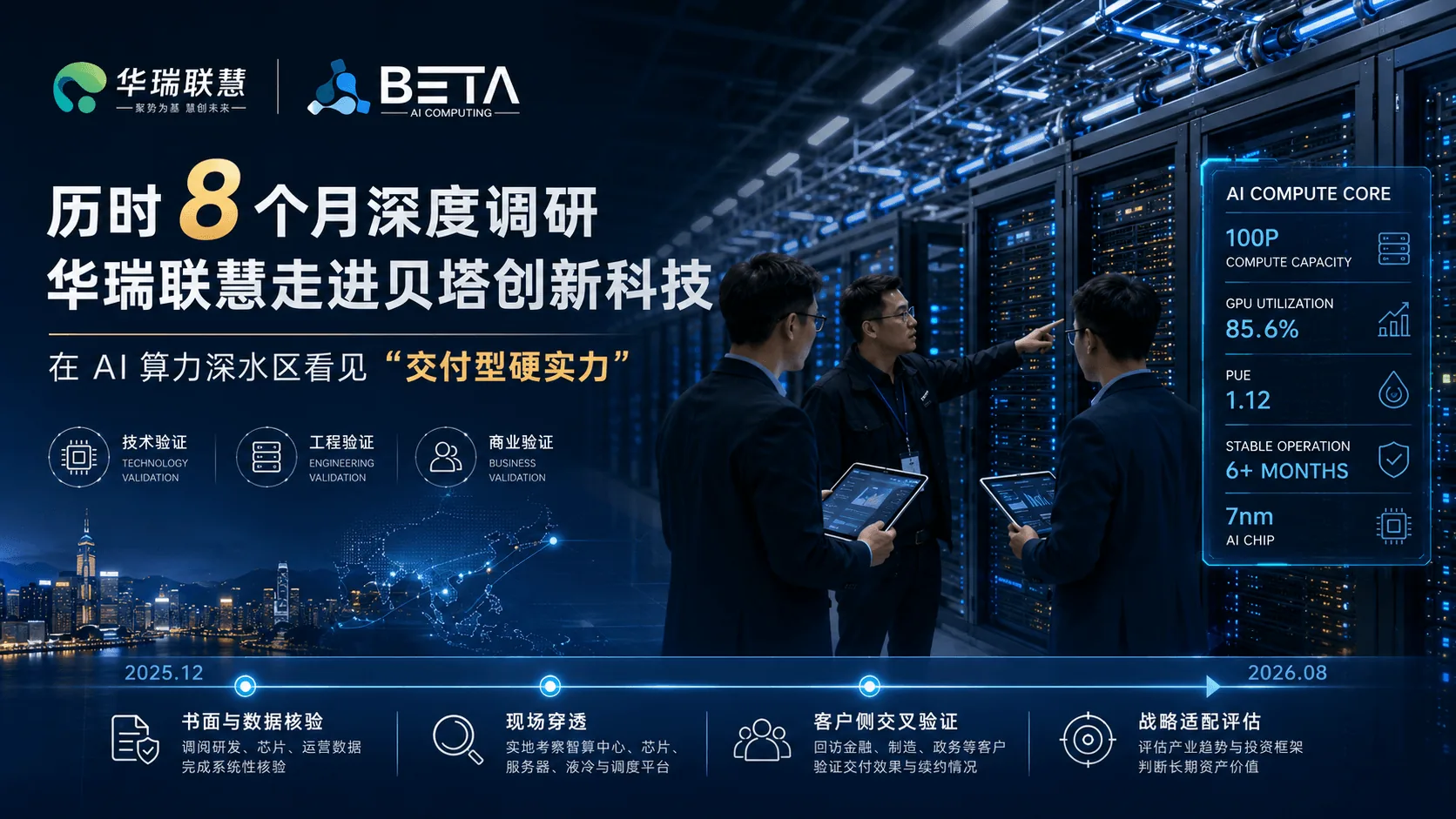
From December 2025 to August 2026, the AI Computing and Industrial Intelligence Research Group of Huarui SmartLink conducted an eight-month systematic assessment of Beta Creative Tech HK Limited. The review extended from Beta’s R&D hub at its Hong Kong headquarters to its 100P AI computing center in the Greater Bay Area, and further to on-site follow-ups with deployed customers across financial services, electronics manufacturing, government services, and other sectors.
Through a three-track approach combining technology validation, engineering validation, and commercial validation, the Huarui SmartLink team carried out a due-diligence-style review covering Beta’s full-stack capabilities.
Eight Months of Investigation: Not the PowerPoint, but the System Actually Running
Huarui SmartLink has always taken a clear approach to the AI computing sector: rather than chasing overheated consensus, the team seeks to rebuild its understanding before the underlying logic of the market shifts.
Following the shockwave triggered by DeepSeek in early 2025, the market began moving from a paradigm of “compute scarcity” toward one centered on cluster efficiency and ROIC validation. Against this backdrop, Huarui SmartLink identified Beta Creative Tech as a priority target for verification in the Asia-Pacific region.
At the heart of the assessment was one question:
As algorithmic efficiency improves and drives down the unit cost of intelligence, which companies can still survive and scale on the strength of their system capabilities and proven delivery track records?
Rather than relying on a single roadshow presentation, Huarui SmartLink conducted the assessment in four stages.
Months 1–2 | Documentation and Data Verification
The team reviewed Beta’s R&D pipeline since its transformation, chip tape-out records, AI computing center PUE data, GPU utilization records, and related operating metrics.
Months 3–5 | On-Site Technical Examination
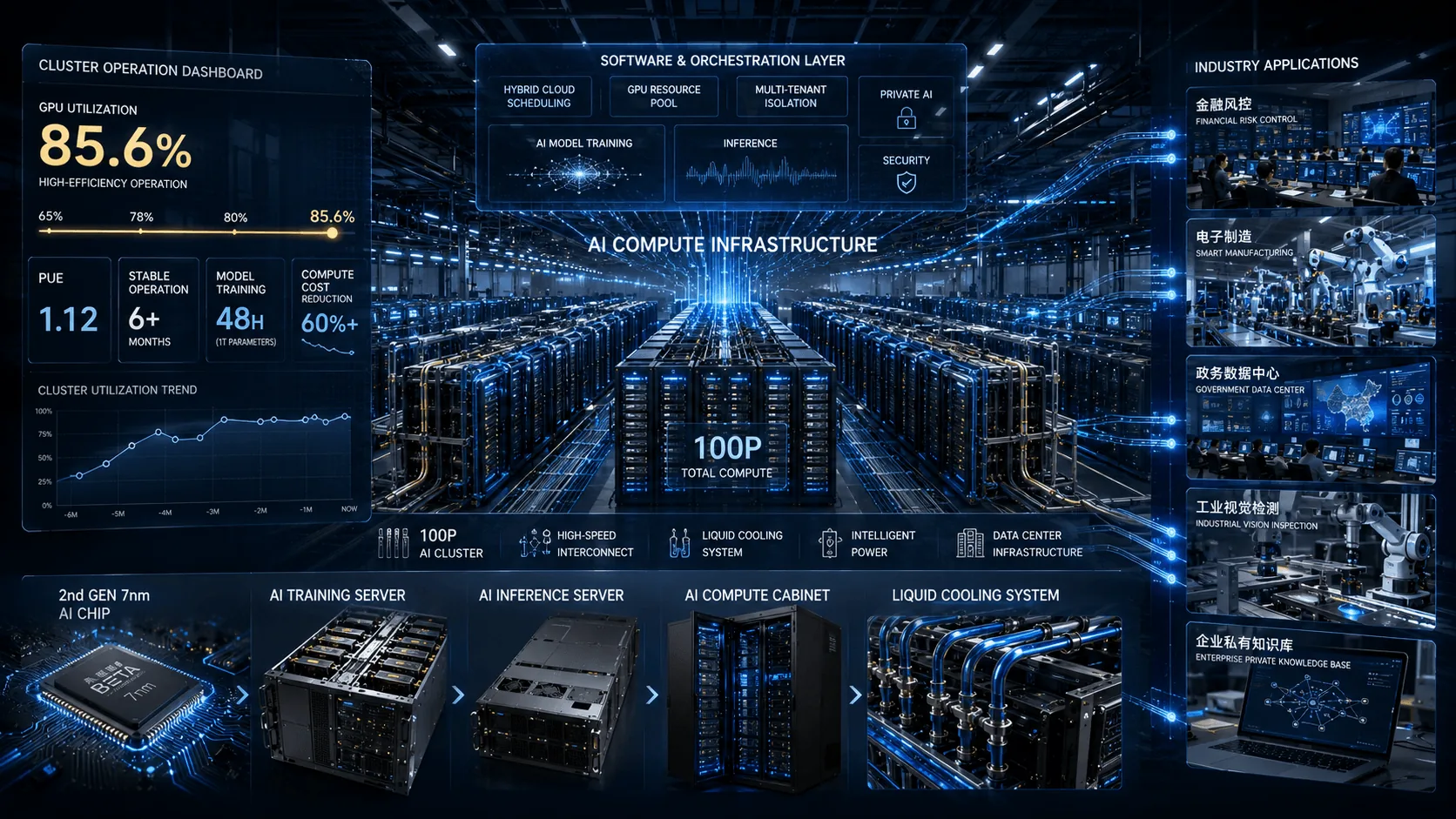
The team conducted an on-site review of the Greater Bay Area AI data center, including its 100P total computing capacity, 85.6% GPU utilization, PUE of 1.12, and more than six months of stable operation.
The review also covered the rack-level deployment of Beta’s second-generation 7nm proprietary AI chips, liquid-cooling infrastructure, and hybrid-cloud computing orchestration platform.
Months 6–7 | Customer-Side Cross-Validation
The research team followed up on deployed projects, including a bank’s privately deployed risk-control large language model, an in-house training center operated by a multinational electronics manufacturer, and government-sector knowledge-base applications.
The objective was to verify whether key commercial outcomes—including renewal performance, an approximately threefold improvement in training efficiency, and compute-cost reductions of more than 60%—had actually been delivered.
Month 8 | Strategic Fit Assessment
Finally, the team evaluated Beta against Huarui SmartLink’s allocation framework of “high-growth industries + strong cash flow + institutional tailwinds,” assessing whether Beta’s integrated model of digital-intelligence infrastructure + digital-intelligence applications + digital-intelligence services could demonstrate through-cycle asset characteristics.
“The first question was straightforward: ‘Can we see the system you actually have running?’—not ‘How do you tell your fundraising story?’”
— A Beta Creative Tech engineer, reflecting on the assessment process
Beta Creative Tech: The “Delivery-Driven” Player in AI Infrastructure
After eight months of investigation, Huarui SmartLink developed a clear view of Beta Creative Tech’s capabilities.
Full-stack proprietary foundation
From AI chip architecture design and training/inference servers to edge nodes, hybrid-cloud compute orchestration, and customized private large-model deployment, Beta covers the entire chain of:
Chip → Infrastructure → Application → Operations
This distinguishes it from vendors whose core capability is primarily third-party system integration and assembly.
Quantifiable delivery track record
Beta’s Greater Bay Area node has maintained stable operation at 100P of computing capacity. In financial-sector deployments, training cycles for large models with hundreds of billions of parameters have been compressed to approximately 48 hours, representing a 60% reduction compared with conventional GPU-based solutions, while compute costs have fallen by more than 60%.
At the same time, customer data can remain 100% privately deployed.
Depth of real-world deployment
Beta has accumulated more than 20 delivered cases across 7+ industries, including finance, government services, electronics manufacturing, healthcare, retail, smart transportation, and other sectors.
Industrial vision, enterprise AI compliance auditing, digital-human platforms, and other applications have moved beyond demonstration-stage projects and into actual production lines and management workflows.
Regional hub positioning
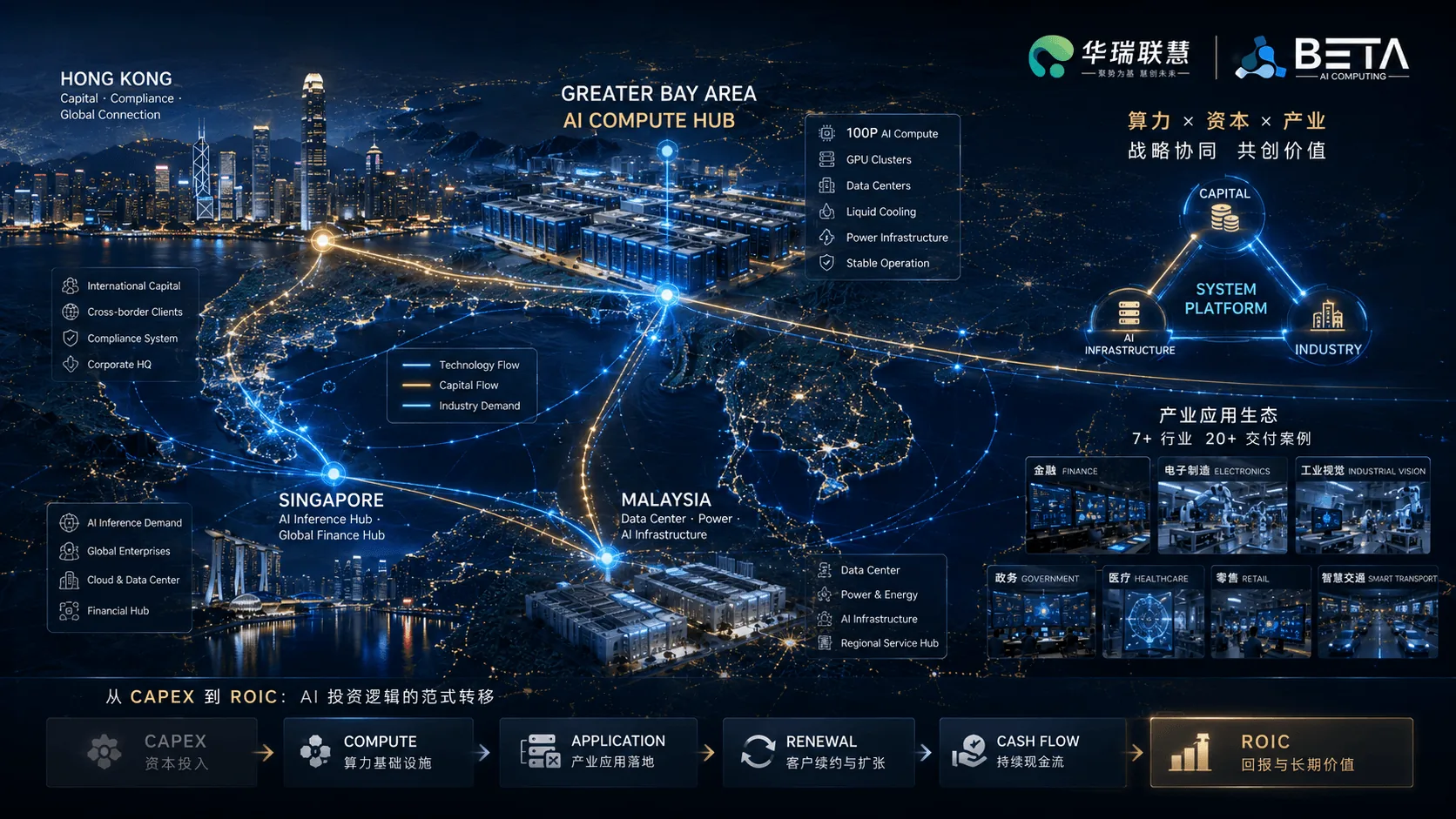
With its headquarters in Hong Kong, infrastructure footprint in the Greater Bay Area, and strategic reach into Southeast Asia, Beta is positioned around a regional structure connecting:
Chinese Technology → Asian Industry → Global Capital
Its 2026 plan targets an AI computing infrastructure footprint equivalent to more than 200MW.
From Huarui SmartLink’s perspective, Beta’s scarcest capability is not any single technology.
Rather, it is the engineering ability to integrate chips, liquid cooling, orchestration, security, and industry-specific knowledge bases into a continuously operating system.
As AI investment in 2026 shifts from a CAPEX narrative toward ROIC validation, this type of engineering and operating capability is increasingly becoming the kind of asset characteristic to which the market may assign a premium.
Assessment Conclusion: From Observation to Collaboration
Following the completion of the eight-month review cycle, Huarui SmartLink reached a clear internal conclusion:
Beta Creative Tech has the potential to emerge as a system-level platform player in the next phase of AI computing infrastructure development.
Its operating philosophy of “Less storytelling, more delivery” is closely aligned with Huarui SmartLink’s emphasis on long-termism and balanced risk-adjusted returns.
Based on the assessment, the two parties have entered substantive discussions regarding potential strategic collaboration, including:
- Jointly mapping the allocation landscape for AI computing infrastructure across Asia-Pacific and evaluating Beta’s nodes for inclusion in Huarui SmartLink’s core AI asset universe;
- Co-developing replicable, auditable, and renewable solutions in areas such as financial compliance, industrial vision, and cross-border compute orchestration;
- Exploring a Hong Kong-centered compute–capital–industry triangular collaboration mechanism to serve two-way demand between Southeast Asia and the Greater Bay Area.
“Eight months was not about being cautious for the sake of caution. It was about understanding the survivor structure created by the efficiency revolution before making a move,” a Huarui SmartLink representative said.
“Beta Creative Tech demonstrates one thing clearly: when the tide recedes from narratives toward actual performance, companies with real computing capacity, real customers, and a proven operating history will be seen.”
Competitive Assessment: Where Beta’s Strengths Actually Lie
As the eight-month assessment entered its final stage, Huarui SmartLink’s investment research team conducted both a horizontal benchmarking exercise and a vertical breakdown of Beta Creative Tech HK.
Our conclusion comes first:
As AI computing transitions from a “CAPEX narrative” to “ROIC validation” in 2026, Beta Creative Tech may not be the company most focused on storytelling, but it is among the relatively small group of delivery-oriented platform players capable of integrating chips, infrastructure, orchestration, and applications into a continuously operating system.
Its competitive strengths are concentrated along three difficult-to-replicate dimensions:
Engineering integration + Regional hub positioning + Private-deployment compliance
1. System Integration: Crossing the 80% Utilization Threshold
The valuation anchor for AI computing centers has changed in 2026.
The market is no longer focused simply on “how many petaflops have been installed.” Instead, attention is increasingly shifting toward effective GPU utilization, PUE, and payback periods.
Operating records from Beta’s Greater Bay Area node show:
100P total computing capacity
More than six months of stable operation
85.6% GPU utilization
PUE of 1.12
Its second-generation proprietary 7nm AI chip has also supported the training of a financial large model with hundreds of billions of parameters within 48 hours, representing a 60% reduction in training time versus conventional GPU solutions and a compute-cost reduction of more than 60%.
For Huarui SmartLink, the significance of these figures is not that they simply “look good.”
The more important point is that the node has moved beyond what the research team regards as the industry’s 80% utilization break-even threshold.
Many newly constructed AI computing centers remain in the 65%–78% utilization range, leaving substantial capacity idle while depreciation continues.
By combining proprietary chips with proprietary orchestration, Beta has pushed utilization above 85%, potentially shifting the unit Token cost curve downward and creating conditions under which ROIC can outperform WACC.
2. Full-Stack Proprietary Capability: Closing the Loop from Chip to Rack
Across today’s AI infrastructure value chain, many third-party AIDC operators essentially follow an integration model:
Buy GPUs + Buy Servers + Procure Liquid Cooling
Under such a structure, a significant portion of gross margin can be captured by upstream suppliers.
Beta has taken a different path:
Second-generation proprietary AI chip
7nm process, 200% performance improvement, integrated training-and-inference architecture
Proprietary training and inference servers and full-rack solutions
Proprietary hybrid-cloud orchestration and multi-tenant isolation platform
Proprietary liquid-cooling architecture, with a PUE of 1.12 as an operating result
Together, these capabilities form a full-stack closed loop:
Chip → Server → Data Center → Private Large Model
This structure gives Beta a differentiated position among financial institutions, government agencies, and other customers with strict requirements for 100% private data deployment, auditability, and technological autonomy.
During customer-side verification, Huarui SmartLink confirmed that both a privately deployed bank risk-control model and an in-house training center operated by an electronics manufacturer had renewed their engagements in part because the proprietary technology stack was auditable and allowed data to remain within the customer’s own environment.
3. Regional Hub Positioning: The Hong Kong–Greater Bay Area–Southeast Asia Triangle
Beta is headquartered in Hong Kong, has deployed infrastructure in the Greater Bay Area, and is strategically expanding toward Southeast Asia.
In 2026, this geographic configuration carries particular significance.
Hong Kong provides access to international capital, compliance frameworks, and trust among cross-border customers.
The Greater Bay Area provides power infrastructure, land, manufacturing supply chains, and operational AI computing nodes.
Southeast Asia, particularly Singapore and Malaysia, provides growing demand for overseas AI inference and enables geographic diversification beyond a single domestic market.
Within Huarui SmartLink’s global allocation framework, assets capable of connecting:
Chinese Technology → Asian Industry → Global Capital
remain relatively scarce.
Beta is neither simply a Hong Kong corporate shell nor a conventional mainland IDC operator.
Its three-way regional positioning may enable it to capture both domestic substitution opportunities and overseas inference demand as global technology supply chains continue to bifurcate.
4. Depth of Applications: 7 Industries, 20+ Cases, and a Focus on Renewal
Competitiveness is not ultimately defined by specifications. It is defined by whether customers come back.
Beta has accumulated more than 20 delivered projects across seven industries, including finance, government, manufacturing, healthcare, retail, transportation, and education.
Industrial vision, enterprise knowledge bases, digital humans, and compliance auditing have entered customers’ actual production and operational workflows rather than remaining at the POC stage.
As capital becomes more selective in 2026, homogeneous large-model companies and pure compute-rental operators face increasing pressure.
By contrast, companies whose performance can be verified through customer electricity consumption, renewal contracts, and measurable reductions in training cycles represent a fundamentally different type of asset.
Throughout its eight-month assessment, Huarui SmartLink classified Beta as an “operating-layer asset” rather than an “equipment-layer trading opportunity.”
The former monetizes OPEX and utilization, while the latter primarily monetizes CAPEX orders.
In an investment environment increasingly focused on ROIC, operating-layer assets may demonstrate greater resilience across cycles.
Within the segment of mid-sized system-level AI platforms in Asia-Pacific, Beta’s competitive position is therefore relatively clear:
Compared with pure IDC operators, it has chips and orchestration.
Compared with pure large-model companies, it has infrastructure and power capacity.
Compared with pure chip start-ups, it has real-world applications and operating nodes.
Huarui SmartLink Conclusion
Over eight months, we sought to answer one question:
After the DeepSeek shockwave, who can survive the efficiency revolution and evolve into a true platform?
Beta Creative Tech’s answer is not to bet everything on a single technological singularity.
Instead, it has worked to weld together chips, liquid cooling, orchestration, and industry-specific knowledge bases into a stable, continuously operating production system, while positioning itself within the Hong Kong–Greater Bay Area–Southeast Asia triangle as a connector between compliance, industry, computing infrastructure, and capital.
This aligns closely with Huarui SmartLink’s post-2026 approach to the AI investment theme:
Move beyond narrative premiums and focus on system-level assets with real utilization, real renewals, proprietary technology stacks, and defensible regional barriers.